A commercial chakli machine setup is more than a single chakli-making machine. Starting a chakli manufacturing business in India needs multiple machines to prepare raw materials, make consistent dough, form the chakli, fry the product and remove excess oil.
A complete setup generally consists of six important machines:
- Roasting Machine
- Pulveriser / Atta Chakki
- Dough Kneading / Atta Mixing Machine
- Chakli Making Machine
- Electric Fryer Machine
- Oil Dryer Machine
Together, these machines create a streamlined chakli production line, helping manufacturers improve consistency, reduce manual work and increase production efficiency.
This guide explains the machines required, their role in the process, the factors that affect setup cost, and how to choose the right machinery for your business.
What Is a Chakli Machine Setup?
A chakli machine setup is a combination of food-processing machines used to manufacture chakli commercially, from raw-material preparation to final oil removal. Instead of depending entirely on manual production, a commercial setup divides the process into individual stages:
Raw Material Preparation → Roasting → Grinding → Dough Mixing → Chakli Formation → Frying → Oil Removal → Packing
The exact machinery and capacity should be selected according to the required daily output, available space, product range, labour availability and budget.
What Machines Are Required for a Chakli Manufacturing Business?
A complete commercial setup requires six major machines. Each one plays an important role in keeping the production workflow efficient.
1. Roasting Machine
The first stage of many chakli recipes involves roasting the required ingredients. A commercial roasting machine gives more consistent roasting than manual batch processing.
Why It Is Important
- More consistent roasting
- Better batch control
- Reduced manual effort
- Easier handling of larger batches
2. Pulveriser / Atta Chakki
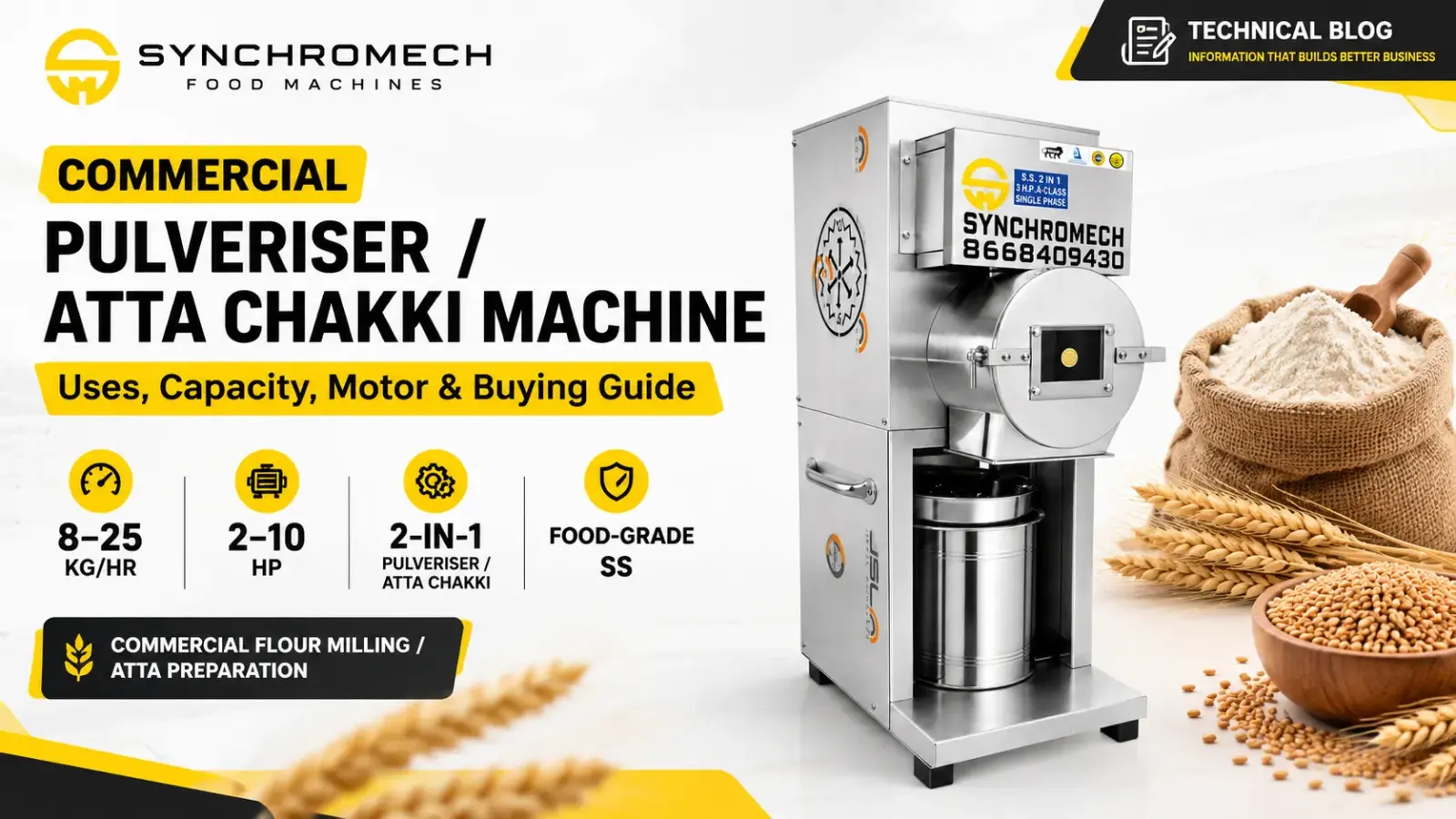
Prepared ingredients may need to be processed into the right flour or powder consistency. A pulveriser or commercial atta chakki grinds them according to your recipe and production requirement.
Benefits
- Consistent grinding
- Faster processing
- Reduced manual labour
- Better batch-to-batch consistency
3. Dough Kneading / Atta Mixing Machine
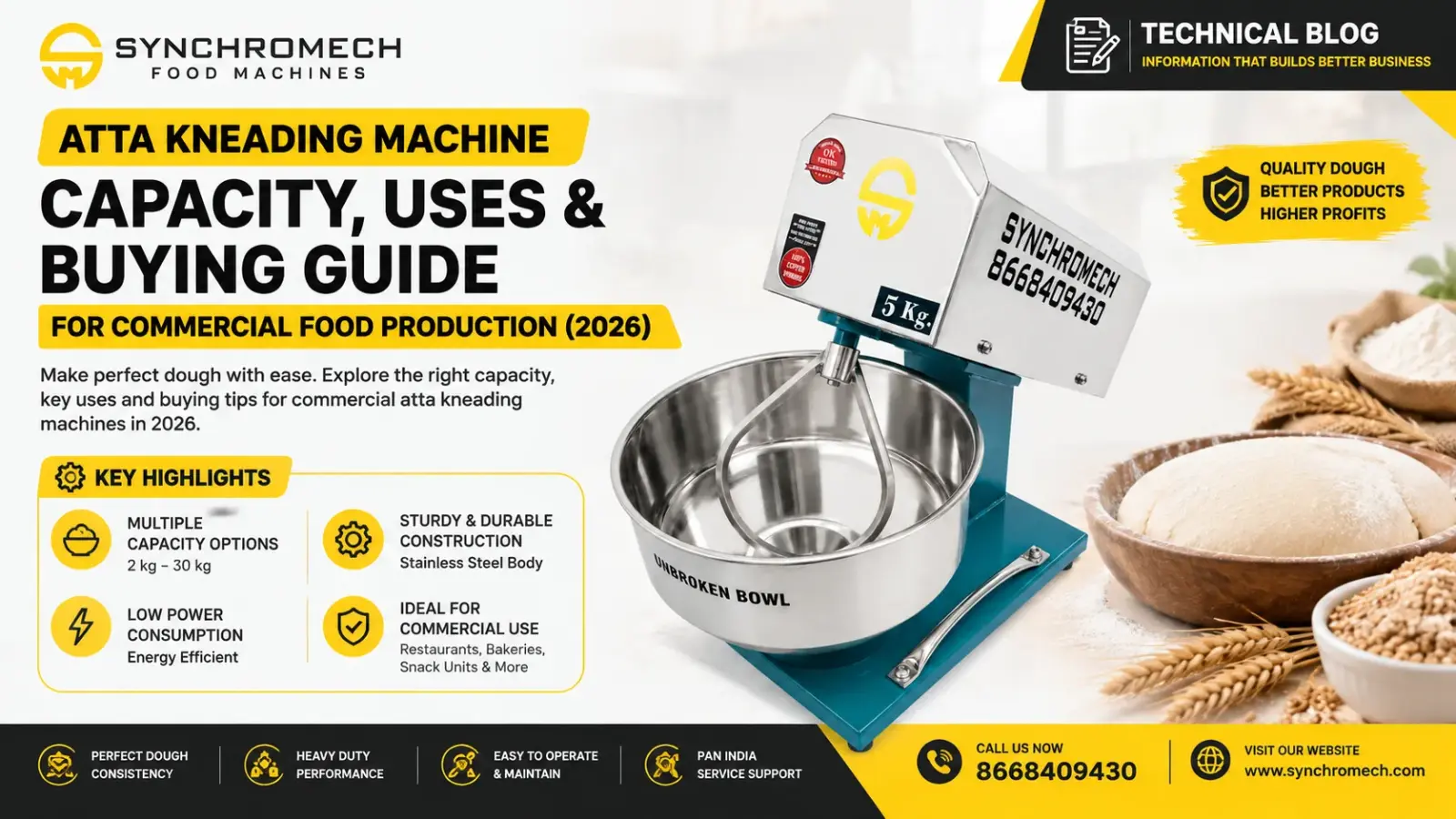
A dough kneading or atta mixing machine becomes important as volumes increase. It helps you handle larger batches while keeping the mixing process consistent.
Benefits
- Consistent dough mixing
- Faster batch preparation
- Better production flow
- Easier handling of larger quantities
4. Chakli Making Machine
The chakli making machine is the core forming machine in the line. Prepared dough is loaded into it and formed into the required shape, removing most of the manual shaping effort.
Depending on the configuration, die and operating settings, it also supports consistent shape and size. See our range of chakali making machines.
5. Electric Fryer Machine
Once formed, the chakli needs to be fried. An electric fryer machine is a key part of the setup because frying becomes one of the major production stages as output increases.
Benefits
- Controlled frying process
- Reduced manual handling
- Easier batch management
- Suitable for commercial production
6. Oil Dryer Machine
Fried chakli carries surface oil that needs to be reduced before cooling, packing and distribution. An oil dryer machine removes excess surface oil from fried snacks.
Why Oil Removal Matters
- Product appearance and texture
- Packaging and shelf presentation
- Handling
- Overall product quality
Chakli Making Machine: The Core of the Production Line
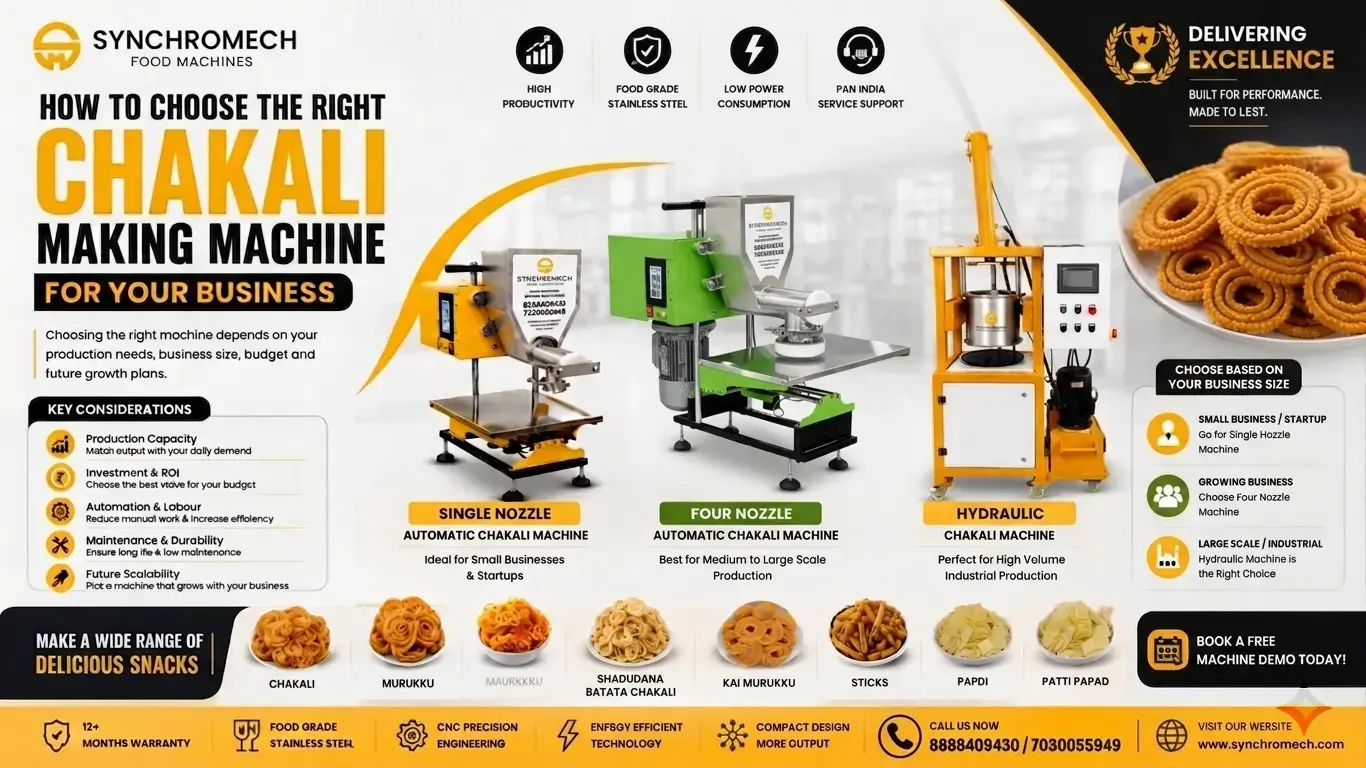
Synchromech currently offers Single Nozzle and Four Nozzle Chakali machines, with published capacities of approximately 7–8 kg/hour and 20–25 kg/hour respectively.
Single Nozzle Automatic
Suitable For
- New entrepreneurs
- Small-scale snack businesses
- Small namkeen manufacturers
- Trial production
Published capacity: approximately 7–8 kg/hour.
Four Nozzle Automatic
Suitable For
- Growing snack brands
- Medium-scale manufacturers
- Commercial namkeen businesses
- Higher-volume production
Published capacity: approximately 20–25 kg/hour.
Hydraulic Chakli Machine
For businesses needing significantly higher production, hydraulic machinery can be considered. Select the machine based on:
- Required production per day
- Available investment
- Factory space and labour
- Product requirements
- Future expansion
Chakli Production Process: Step-by-Step
A commercial chakli manufacturing process can generally be organized into these stages.
Raw Material Preparation
Prepare and measure the required ingredients according to the product recipe.
Roasting
Ingredients that need roasting are processed in the roasting machine.
Grinding / Pulverising
Prepared ingredients are processed in a pulveriser or atta chakki to the required consistency.
Dough Mixing
The ingredients are mixed and kneaded in a commercial dough kneading or atta mixing machine.
Chakli Formation
Prepared dough is loaded into the chakli making machine and formed into consistent shapes.
Frying
The formed chakli is fried in a commercial electric fryer.
Oil Removal
The fried product goes through an oil dryer to reduce excess surface oil.
Cooling and Packing
The finished chakli is cooled, inspected and packed for sale.
Chakli Machine Setup Layout
A well-planned production layout should follow the natural direction of production:
Raw Material Area → Roasting Machine → Pulveriser / Atta Chakki → Dough Mixer → Chakli Making Machine → Electric Fryer → Oil Dryer → Cooling & Quality Check → Packaging → Finished Goods Storage
This arrangement reduces unnecessary movement of materials and improves workflow.
How Much Does a Chakli Machine Setup Cost in India?
The chakli machine setup cost in India depends on the type, capacity and specification of each machine. There is no single fixed price for a complete setup, because the investment changes with:
- Production capacity and machine automation
- Number of nozzles
- Fryer, dough mixer, roasting, pulveriser and oil-drying capacity
- Stainless-steel specification
- Electrical requirements and customization
- Installation, packaging equipment and factory infrastructure
So instead of looking only at the chakli machine price in India, calculate the investment for the complete production line.
Major Investment Components
| Setup Component | Investment Consideration |
|---|---|
| Roasting Machine | Capacity and automation |
| Pulveriser / Atta Chakki | Grinding capacity |
| Dough Mixer | Batch capacity |
| Chakli Machine | Nozzle and production capacity |
| Electric Fryer | Frying capacity |
| Oil Dryer | Batch/output capacity |
| Electrical Setup | Power requirements |
| Packaging | Manual or automatic |
| Installation | Setup and commissioning |
| Factory Infrastructure | Space, ventilation and utilities |
For an exact current quotation, the supplier should evaluate your required production capacity and configuration rather than quote a generic setup price.
What Production Capacity Should You Choose?
The right chakli production machine depends on how much product you plan to manufacture.
Small Production Business
- Lower initial investment
- Compact machinery
- Smaller batches
- Local retail and direct-to-consumer sales
Medium-Scale Business
- Higher-capacity dough mixing
- Automatic chakli forming
- Commercial frying and oil drying
- Dedicated packing and raw-material storage
Large-Scale Production
- High-output chakli machines
- Continuous frying systems
- Industrial roasting and larger mixers
- Automated packaging and quality control
How to Choose the Right Chakli Machine Setup?
Before investing in a chakli manufacturing machine, evaluate these factors.
Required Daily Production
First determine your expected daily production in kilograms. Don't select a machine only because it has the highest capacity; choose according to actual demand and planned expansion.
Production Line Balance
All six machines should be reasonably balanced. A high-output chakli machine adds little value if the dough mixer or fryer cannot handle the same volume.
The goal is a balanced production line, not simply the fastest machine.
Available Factory Space
Consider machine dimensions, operator movement, raw-material and finished-product storage, the frying and packaging areas, and maintenance access.
Automation Level
Compare manual, semi-automatic and automatic processes against your production volume, labour availability, budget, product consistency needs and future expansion.
Food-Grade Construction
Food-contact components should suit hygienic food production. Synchromech states that its Chakali machines use food-grade stainless steel construction and are designed for consistent production and durability.
Power Requirements
Check voltage, phase, connected load, motor power, daily operating hours and your electrical infrastructure. Synchromech lists its Single Nozzle and Four Nozzle Chakali machines with a 230 V single-phase supply and power consumption of 0.5 HP and 1 HP respectively.
Always confirm the final electrical requirement with the manufacturer for your selected configuration.
Business Requirements for Starting a Chakli Manufacturing Unit
Machinery is only one part of a commercial chakli business. A proper setup should also consider the following.
Production Space
Adequate space for machinery, operators, raw materials, finished products and packaging.
Raw Materials
A reliable supply chain for the ingredients your chakli recipe needs.
Labour
The number of operators depends on the automation level and production capacity.
Electricity
Electrical infrastructure that can safely handle the connected load of all the equipment.
Packaging
Select packaging according to product quantity, shelf-life requirements, distribution channel, retail requirements and branding strategy.
Food Safety & Compliance
Before commercial production, identify and comply with the applicable food-business registration, safety, labelling and local regulatory requirements in India.
Who Can Start a Chakli Manufacturing Business?
Food Entrepreneurs
Entrepreneurs planning to enter commercial snack manufacturing.
Namkeen Manufacturers
Existing manufacturers looking to expand their production.
Women's Self-Help Groups
Small food businesses and groups entering commercial snack production.
Regional Snack Brands
Growing regional brands requiring consistent commercial production.
FMCG Businesses
Businesses adding chakli and similar snacks to their product portfolio.
Wholesale Suppliers
Businesses supplying packaged snacks to distributors and retailers.
Why Choose an Automatic Chakli Making Machine?
Moving from manual production to an automatic chakli making machine offers several operational advantages.
Consistent Shape
Automated forming helps maintain a more consistent product shape.
Higher Productivity
Machine-based production processes larger quantities than manual shaping.
Less Labour Dependency
Automation reduces the amount of manual shaping work required.
Better Production Planning
Known machine capacity makes it easier to estimate production requirements.
Business Scalability
A properly selected production line can support future growth.
Synchromech describes its Chakali machines as suitable for small businesses as well as larger food-production operations, highlighting productivity, consistent quality, ease of operation and reduced manual effort as key benefits.
Common Mistakes to Avoid
Before investing in a chakli manufacturing setup, avoid these common mistakes.
Buying Only the Chakli Machine
A complete business needs supporting equipment for preparation, frying and oil removal.
Choosing Capacity Without Calculating Demand
Don't purchase equipment solely on maximum capacity.
Ignoring the Frying Stage
Frying can become a production bottleneck.
Ignoring Oil Removal
Oil removal is an important part of finished-snack handling and packaging.
Not Planning the Factory Layout
Poor layout increases material movement and operational inefficiency.
Choosing a Supplier Only on Price
Also consider machine quality, specifications, installation, training, warranty, spare parts and after-sales support.
Choose the Right Setup
How to Get the Right Chakli Machine Setup for Your Business
There is no single best chakli machine setup for every business. A startup, a regional namkeen manufacturer and a large FMCG manufacturer all have different production requirements. Determine these five factors first:
Daily Production
Determine the expected daily output.
Product Range
Identify the snacks you plan to manufacture.
Available Space
Plan the factory and production layout.
Budget
Plan investment according to the required capacity.
Future Expansion
Choose equipment that can support business growth.
Then select the capacity of each machine so the entire line works efficiently.
Synchromech is a food-processing machinery manufacturer based in Chhatrapati Sambhajinagar (Aurangabad), Maharashtra, and states that it has been manufacturing food-processing machinery since 2017.
Have Questions?
Frequently Asked Questions
Conclusion
Final Thoughts
Starting a chakli manufacturing business in India requires more than buying a chakli machine. A well-planned setup combines raw-material preparation, dough processing, automatic forming, frying and oil removal, using a Roasting Machine, Pulveriser / Atta Chakki, Dough Kneading / Atta Mixing Machine, Chakli Making Machine, Electric Fryer and Oil Dryer.
The right combination depends on your production target, investment capacity, factory space, labour and future plans. A balanced production line improves efficiency and supports growth.
The important question is not just "Which chakli machine should I buy?" but "What complete setup will give me the right capacity, consistency and scalability?" If you're unsure, talk to the Synchromech team or view all machines.